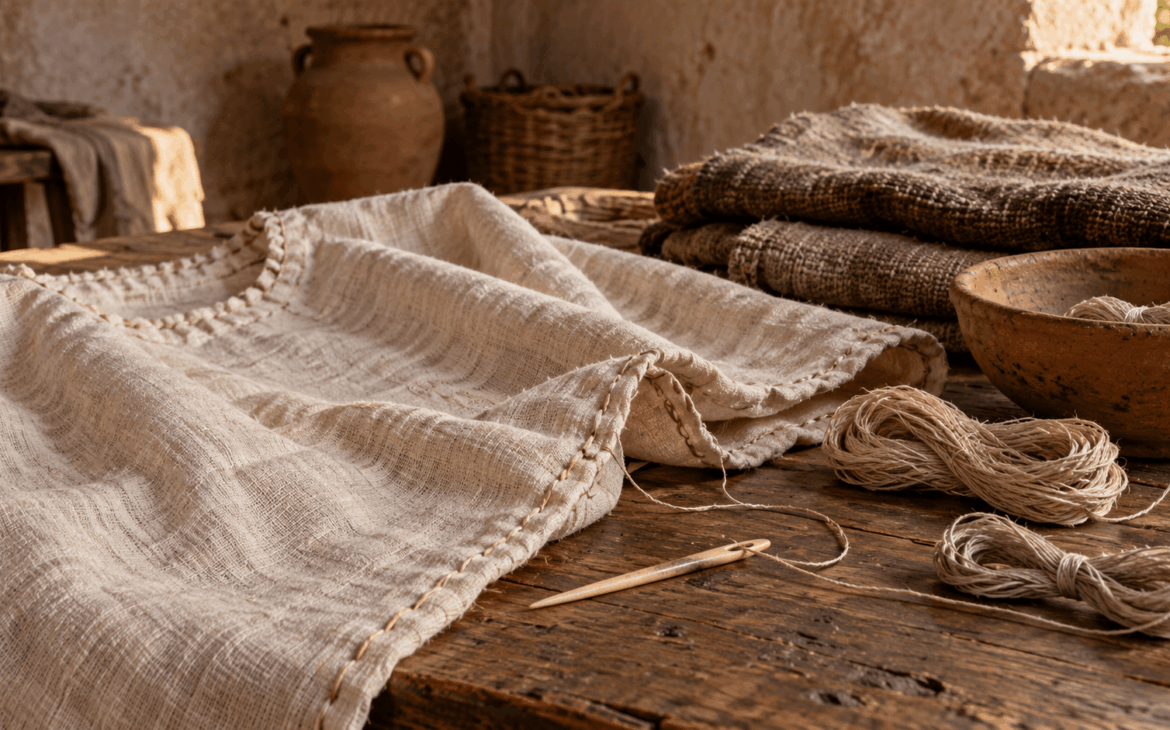
Making Things
My grandmother made things.
Sometimes people talk about core memories, those moments that are etched in your brain that you’ll never forget. I’ll never forget all the times I walked into my grandparents’ house and saw my grandmother sitting in her chair with a small table beside her. There was a lamp on the table that was always on. And in her hands were a needle, thread, and a thimble.
She loved to sew and she loved to make things.
Every year as Christmas approached, I would get a call from my dad with the same question, “What do you want Granny to make you this year for Christmas?” As a teenager, the answer to that question was, “Nothing!” I wanted money. I wanted expensive things. I wanted the latest gadget, speakers for my truck, some new Nikes!
But my grandmother couldn’t get me any of those things. However, she could make me something.
One year, I had an idea. At this point, I had been a youth minister for several years and, when you’re a youth minister, you end up with approximately 1,000 t-shirts from all the retreats, mission trips, and events. Many of those t-shirts I had designed. My grandmother knew how to make quilts and so I took her a box of t-shirts. That Christmas, she gave me a quilt made from those t-shirts.
That quilt is one of my most treasured possessions.
Over the years, she made things for me, for my wife, for our kids. Needlepoint pictures with a frame that my grandfather made in his shop. Clothes for the kids when they were small that Alisha may or may not have let them wear in public. Different things, some we appreciated and others we didn’t know what to do with, but they were all handmade with love.
But my grandmother didn’t just make things for her family.
The congregation she attended supported a mission point in Honduras. She heard one Sunday that there were kids there who didn’t have much. Well, my grandmother figured she could help out with that and she went to work making these little stuffed bears. She would make dozens of them, working every day in her chair. That was her ministry. Her work. A way she could serve. A way she could help.
She made a difference.
Small Acts of Kindness Can Make a Lasting Impact
Sometimes, I think we forget the power we have, how our small acts of kindness can make a lasting impact and a real difference in the lives of others. We live in a world that tells us if you want to make a difference you need a platform, a podcast, and a following on social media. That your voice has to be heard, and it has to be loud. We’ve been told that influential people who make a difference have power and position.
We’ve been lied to. And, we know it.
Think back over your life and consider for a moment the people in your life who have made the biggest difference in your life.
Chances are, most people wouldn’t know their name. But you know their name.
They probably didn’t make the headlines or ever get their 15 minutes of fame, but they are on the Mount Rushmore of your life.
Why? Because…, well, because of their kindness toward you.
Sometimes we forget that a life of kindness can make a lasting impact and, what’s more, can even elevate and extend our witness as disciples of Jesus!
Sometimes we forget what hangs in the balance of our decision to be kind and to do kind things. What hangs in the balance is our witness.
There’s an old preacher line, I’m sure you’ve heard it before: If you were put on trial for being a Christian, would there be enough evidence to convict you?
Tabitha: A Disciple Known for Her Kindness
There was enough evidence for a little known woman in Scripture by the name of Tabitha. The author of Acts was a man named Luke and he writes this story of how the Gospel, the Good News about Jesus, spread from Jerusalem to Judea, Samaria, and the ends of the earth (Acts 1:8).
As the Gospel spreads, it is having an impact on people and places near and far, Jews and Gentiles, the Spirit of God is moving and Luke is recording what is happening as more and more people are coming to faith in Jesus and making the decision to become His disciples.
The fact that people who are not Jews are coming to faith is big news. And Luke is getting ready to share how the full extent of God’s love will be extended to all. But before he does that (in the very next chapter with Cornelius) he drops in this important story about a woman who lived in the port city of Joppa named Tabitha.
36 There was a believer in Joppa named Tabitha (which in Greek is Dorcas). She was always doing kind things for others and helping the poor.
In this day and time, Joppa was an important city. It was on the coast. It was a center for imports and exports. Ships were coming and going all the time, and the city was an epicenter for the economy of that region.
So you can imagine how diverse the city of Joppa was. How the streets were filled with all kinds of people from all over the world. In a city like that, there were those people who everybody knew, the movers and shakers, the important people, the wealthy and powerful who held high positions and influence.
But Luke doesn’t tell us any of their stories. No. He says, in Joppa, there’s this woman that everyone should know about. Her name is Tabitha. That was her name in Aramaic. In Greek, because many people spoke Greek, Luke himself was likely Greek, her name was Dorcas. Both Tabitha and Dorcas carry the same meaning. The name means gazelle. And she was a believer, a disciple. In the original language, this is the word “female disciple.” μαθήτρια (mathētria).
What is interesting about that is that this is the only place in the entire NT where this word is used. Luke is clearly pointing out that Tabitha is a disciple of Jesus.
Women Who Followed Jesus
Tabitha isn’t the only female disciple of Jesus we know about. In fact, there were many.
- Mary Magdalene (Luke 8:1–3; John 20:1–18).
- Joanna (Luke 8:3; Luke 24:10).
- Susanna (Luke 8:3).
- Mary of Bethany (Luke 10:38–42; John 12:1–8).
- Martha (John 11:27).
- Mary, the mother of Jesus (Acts 1:14).
- Salome (Mark 15:40–41; Mark 16:1).
- Mary the mother of James and Joseph (Matthew 27:55–56; Mark 15:40–41).
- The women from Galilee who supported the ministry of Jesus (Luke 8:1–3; Luke 23:49; Luke 23:55–56; Luke 24:1–10).
- Then there was Priscilla (Acts 18:18–26; Romans 16:3).
- Lydia (Acts 16:14–15; Acts 16:40).
- Phoebe (Romans 16:1–2).
- And Junia (Romans 16:7).
Tabitha is next in a long line of women who were followers of Jesus.
And Luke says this is what you need to know about her:
She was always doing kind things for others and helping the poor.
Full stop. I mean, you could put that on my tombstone and I would be happy. What about you!?? This is how Tabitha was known. She was known for her kindness. After telling us her name and where she lived, this is the one sentence description, the headline, that Luke writes about Tabitha.
She was always doing kind things for others and helping the poor.
And then, Luke tells us what happened…
37 About this time she became ill and died. Her body was washed for burial and laid in an upstairs room.
A Community That Felt Her Loss
Tabitha, a woman renowned for her acts of kindness, has died.
And when she passed, the whole community felt it.
It may not have made the headlines in Joppa or been featured on the evening news, but people felt it when Tabitha got sick and died.
So much so, that the other believers in Jesus, the other disciples, thought to themselves… maybe this story isn’t over yet.
Typically, after washing a body for burial, you would not place it in an upstairs room. This is unusual. Under normal circumstances, people would continue the burial process which would include things like anointing the body, wrapping it for burial, and burying the body. But this process is put on pause. (2 Kings 4)
Why? Luke says…
38 But the believers had heard that Peter was nearby at Lydda, so they sent two men to beg him, “Please come as soon as possible!”
Why did they want Peter to come?
Here’s what I love about these first century disciples of Jesus. They had no doubt about what was possible through the power of God. They understood something about God’s sovereignty, so they did not have any preconceived ideas that God had to do or would do what they wanted Him to do. But at the same time, they were filled with unparalleled hope because they knew nothing is impossible for God.
Peter gets the call, “We need you, now!”
And Peter comes! Peter had seen Jesus resurrect the dead, but you have to wonder what was going through Peter’s mind.
39 So Peter returned with them; and as soon as he arrived, they took him to the upstairs room. The room was filled with widows who were weeping and showing him the coats and other clothes Dorcas had made for them.
Remember how Luke told us that Tabitha was always doing kind things for others and helping the poor.
Her Kindness Was Her Witness
Here, we find out exactly what that meant.
Tabitha, also known as Dorcas, took it upon herself to take care of the widows in her community.
And when Peter walked in the room, they all wanted to show Peter what she had done for them.
“Look at what she made me.”
“She did this one for me.”
“Isn’t this beautiful.”
“I needed something new to wear, what little I had turned to rags. She made this for me.”
One by one, every widow gave a testimony about the kindness Tabitha had done for them.
Her kindness was her witness.
And her kindness was making a difference in the Kingdom!
Peter is overwhelmed. This is the same Peter who preached on Pentecost and saw 3,000 people baptized on one day. This is the same Peter who walked on water with Jesus. The same Peter who boldly declared,
You are the Christ, the Son of the Living God.
Now he’s in an upper room in Joppa.
But he had been in an upper room with Jesus before. On the night He was betrayed, Jesus had washed his feet in an upper room. And then told him to go and do likewise. Find ways to serve others in humility and love.
Disciples Do What They See Their Teacher Do
Peter, like Tabitha, was a disciple of Jesus. Do you know what disciples do? Disciples do what they see their teachers do. To be a disciple is literally to be a learner, an apprentice. As a disciple, you watch your teacher, learn from him, and then do what he does.
Peter has seen Jesus do many things. And he remembers more than one occasion where Jesus was confronted with death. So Peter does what Jesus would do.
40 But Peter asked them all to leave the room; then he knelt and prayed. Turning to the body he said, “Get up, Tabitha.”
Luke, the author of this story, told a very similar story in his Gospel. Jesus was asked to come to the house of a man named Jairus to heal his dying daughter. Jesus came, but when he arrived they told him that the girl had already died.
Jesus went into the room and asked everyone to leave except for her parents, and PETER, James and John.
Peter was in the room.
Jesus took the little girl by the hand and said:
Little girl, arise.
Mark also records this story and preserves the original Aramaic that Jesus spoke.
“Talitha koum” – “Little girl, arise.”
Peter’s words to Tabitha, if spoken in Aramaic, would have sounded almost identical:
“Tabitha koum “- “Tabitha, arise.”
The only difference is one consonant.
Peter does what he saw Jesus do. And when he did, Luke says…
And she opened her eyes! When she saw Peter, she sat up! 41 He gave her his hand and helped her up. Then he called in the widows and all the believers, and he presented her to them alive.
If the story stopped right there, it would be a powerful story.
If this were the end of the movie and the credits began to roll, we would all be amazed and supremely satisfied.
But Luke gives us one more line that for me, makes all the difference. He tells us…
42 The news spread through the whole town, and many believed in the Lord.
A Life of Kindness Can Make an Eternal Difference
Don’t miss the trajectory of this story.
Tabitha’s life of kindness
set up a powerful kingdom witness
and through that, many people heard the Good News about Jesus and believed in the Lord!
Her kindness had an exponential kingdom impact. Her witness, rooted in kindness, made a real and tangible difference.
What Will People Remember About You?
Have you ever wondered if you’re making a difference? I know I have.
When your story comes to an end, what will people hold up and remember about you?
There is an old story about a Rabbi who lived right before Jesus came on the scene. His name was Rabbi Hillel. In fact, Hillel was probably an old man when Jesus was born. He was widely respected. According to the Babylonian Talmud, a Gentile came to Rabbi Hillel the Elder and said he would convert to Judaism if Hillel could teach him the whole Torah while standing on one foot.
Hillel replied: “What is hateful to you, do not do to your neighbor. That is the whole Torah; the rest is commentary. Go and learn it.”
You may be thinking, that sounds a little like what Jesus once said, we call it the Golden Rule!
Do unto others as you would have them do unto you.
The truth is, kindness is a fruit of the Spirit. If you want to know if the fruit of the Spirit is evident in you, consider this: What would people hold up and show others, “Look what they did for me.”
When you come to the end of your life, what will people hold up?
Here’s what I believe is true:
A life of kindness can become a witness that makes an eternal difference.
Disciples make a difference by always choosing kindness.
And in a world full of hate and hurt, division and darkness, a world where even Christians are mean to each other and to others, we need to bring back a spirit of kindness. Kindness is a fruit of the Spirit and it should be evident in our lives.
God’s Kindness Leads Us to Repentance
Not only is kindness a fruit of the Spirit, it’s exactly what you and I needed in order to be saved from our sin.
The Apostle Paul once asked:
Do you not realize that God’s kindness is meant to lead you to repentance?
God, in His kindness, has been gracious to us. Through Jesus Christ and His sacrifice at the cross, He has saved us. And because God has extended His kindness toward us, we get to extend His kindness to others.
Choose Kindness in Everyday Life
Here are three ways to put kindness into practice:
- Say something KIND to someone.
- Do something KIND for someone.
- Pray for the fruit of the Spirit of Kindness to be evident in your life.
Whatever You Did for the Least of These
At the end of the Gospel of Matthew, Jesus reminds us about the power of kindness. He tells this story about judgement day.
34 “Then the King will say to those on his right, ‘Come, you who are blessed by my Father; take your inheritance, the kingdom prepared for you since the creation of the world. 35 For I was hungry and you gave me something to eat, I was thirsty and you gave me something to drink, I was a stranger and you invited me in, 36 I needed clothes and you clothed me, I was sick and you looked after me, I was in prison and you came to visit me.’
—Matthew 25:34-36, NIV
37 “Then the righteous will answer him, ‘Lord, when did we see you hungry and feed you, or thirsty and give you something to drink? 38 When did we see you a stranger and invite you in, or needing clothes and clothe you? 39 When did we see you sick or in prison and go to visit you?’
—Matthew 25:37-39, NIV
40 “The King will reply, ‘Truly I tell you, whatever you did for one of the least of these brothers and sisters of mine, you did for me.’
—Matthew 25:40, NIV
On that day when Tabitha died, I have no doubt she heard Jesus say,
Come, you who are blessed by my Father; take your inheritance, the kingdom prepared for you since the creation of the world.
God has extended His kindness to us.
On the cross of Calvary, Jesus extended His kindness toward us.
But when the kindness and love of God our Savior appeared, he saved us, not because of righteous things we had done, but because of his mercy.
As disciples of Jesus, we extend His kindness to others.
The world will know we are HIS disciples by our love. (John 13:35)
And by doing so, we are blessed and we are saved!
(Titus 3:4–5; Romans 2:4).
Be kind, for the Father has been kind toward us.
Love well, my friends, for the Father first loved us! (1 John 4:19)
Want more from this series? Click here.